What actually happens in your body during Reiki healing?
Oh, Reiki healing! That Japanese mystery that some swear by, while others shake their heads. Maybe you've considered trying it yourself, but wonder if anything actually happens – or if it's all just placebo effect and good vibes? That's actually a really good question, because even though Reiki has existed for over a hundred years, we still don't know exactly what goes on in the body during a session.
But let's dive into what we actually know – and what we don't know yet.
Reiki in English: What's it actually about?
Reiki was founded by Dr. Mikao Usui in Japan in the early 20th century. The name "Reiki" comes from the Japanese words "rei" (universal) and "ki" (life energy), and describes a practice where the healer functions as a channel for universal life energy.
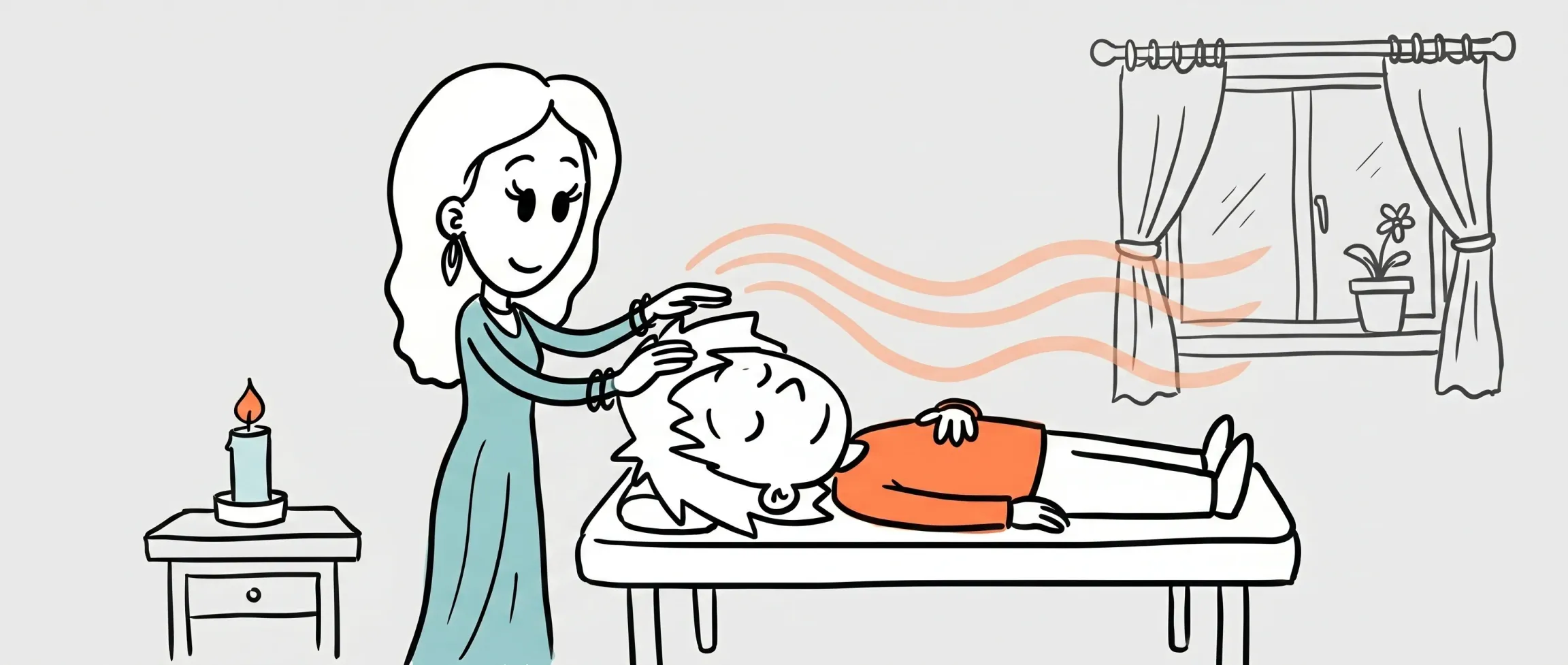
In a Reiki session, the practitioner functions as a channel for universal life energy, which helps the recipient release tensions and restore inner balance. You lie fully clothed on a table, while the healer places their hands on or over different parts of your body – and then the energy is supposed to start flowing.
But what actually happens inside your body when this is going on?
The scientific paradox: What can we measure?
When we look at the science behind Reiki, we encounter an interesting paradox. On one hand, most research on Reiki is poorly designed and prone to bias, and there is no reliable empirical evidence that Reiki helps treat any medical condition.
On the other hand, many people report positive experiences. A small study with 16 cancer patients who had just completed chemotherapy showed that reiki healing was better at reducing fatigue than ordinary relaxation. It may not be the big breakthrough, but it suggests that something actually happens.
Although scientific research on Reiki is limited, there are some studies showing positive effects on stress reduction, pain relief and emotional wellbeing. The problem is just that we don't quite know why.
What happens practically in the body?
Although we can't measure "universal life energy" in a laboratory, we can actually observe some physiological changes during Reiki sessions.
The relaxation response
One of the most documented effects is activation of the body's parasympathetic nervous system – the one that controls our "rest and digest" state. Reiki often creates a calming effect, which can reduce anxiety and mental chatter. When you lie still in a quiet room where someone focuses positively on your wellbeing, something measurable actually happens: heart rate stabilizes, blood pressure can drop, and stress hormones decrease.
Pain perception and endorphins
Reiki can help relieve pain by stimulating the release of endorphins, the body's natural painkillers. That's actually quite logical – deep relaxation and positive attention can trigger the body's own "medicine".
The immune system
Some studies suggest that Reiki can strengthen the immune system. This also makes sense when we know how closely connected stress and immune function are.
The reality: How do we use Reiki?
Nearly half of cancer patients are involved in alternative or complementary treatment while receiving conventional cancer treatment. Reiki healing is one of the alternative treatments they often seek.
It's actually quite impressive that so many people choose to combine the best of both worlds. Cancer organizations have begun to recommend healing before, during and after chemotherapy, as it has been proven that all cancer patients who have received healing can better cope with the harsh medical treatment.
In a project supported by a cancer organization, 15 cancer patients with various diagnoses and disease stages were offered eight treatment sessions with a Reiki healer. Several participants explained that Reiki healing helped them get out of an emerging depression and process various psychological aspects of cancer.
It may not be so much about "curing" cancer, but about giving people tools to handle a difficult situation better.
Energy and science: Where do the two worlds meet?
Here comes the interesting part: While science cannot prove the existence of "qi" or "life energy", both traditional Chinese medicine and other cultures work with the concept of a universal life force and life energy.
Quantum physics is a branch of physics that describes the fundamental laws and properties of energy and matter at the smallest scales. Some theorists speculate whether there could be connections between quantum physics' energy concepts and what Reiki practitioners call life energy.
But be careful – this doesn't mean quantum physics "proves" Reiki. It just means we may not yet have the right tools to understand what's going on.
What can you expect during a session?
If you decide to try Reiki, it's good to know what practically happens. A Reiki treatment typically involves the recipient lying comfortably on a table, fully clothed, while the practitioner gently places their hands on or just above the body.
During a Reiki treatment, the recipient may experience a range of sensations, including warmth, tingling or a feeling of deep relaxation. Some people feel a sudden warmth or tingling in the body, others feel a pleasant flow of peace and wellbeing running through the body – while others feel nothing.
And that's actually completely okay! The healing works regardless of whether you feel something or not.
Placebo or real effect?
The big question is of course: Is it just placebo? William T. Jarvis from The National Council Against Health Fraud stated in 2011 that there "is no evidence that clinical Reiki's effects are due to anything other than suggestion" or the placebo effect.
But even if it's "only" placebo, it's actually still pretty amazing. The placebo effect is proof of how powerful the mind-body connection is. If your brain believes something helps you, it can actually set healing processes in motion.
The conversation and collaboration between patient and healer plays a big role, and it can possibly reduce anxiety, relieve pain and increase overall physical and psychological wellbeing. In our busy world, where we rarely get that kind of attention and peace, it's maybe not so surprising that the body reacts positively.
The practical approach: What works for you?
Instead of getting stuck in the discussion about whether Reiki is "real" or not, it might be more constructive to ask: Does it help you?
Reiki is often considered a complementary therapy, which means it can be used as a supplement in connection with conventional medical treatment. It is not a replacement for medical treatment, but it can be a useful addition to a treatment plan.
If you experience less stress, better sleep and increased wellbeing after Reiki sessions, then that's valuable – regardless of what the mechanism behind it is.
Conclusion: The mystery continues
So what actually happens in your body during Reiki healing? The honest answer is: We don't quite know. We can measure some physiological changes – relaxation, changes in stress hormones, maybe influence on pain registration. But the actual "energy transfer" remains a mystery to science.
Maybe that's okay too. Sometimes we don't need to understand everything to benefit from it. What we know for certain is that many people feel better from Reiki, and that it can be a valuable supplement to conventional treatment.
Remember to use your common sense and notice what works for you specifically. The body is wise – it often knows what it needs, long before science can explain why.