Can the power of thought really change your reality? The truth about hypnosis
Are you also one of those who thinks of swinging watches or hypnotist shows when someone mentions hypnosis? Then you're certainly not alone. But what if I told you that this somewhat mysterious state is actually something we all experience every single day – and that it can help with everything from pain to anxiety?
As a writer at CareClub, I've delved into the research on hypnosis, and I was actually quite surprised by how much science actually knows about this fascinating state. So let me take you on a journey of discovery into a world that is far less mysterious than you might think.
What actually happens in the brain during hypnosis?
Research doesn't have a clear answer as to why, but it's probably related to the fact that hypnosis makes us more receptive to external input, and that we can actually do more than we think through the power of thought. This is what professor at the Institute of Psychology at Aarhus University Bobby Zachariae tells us, who has researched hypnosis since the late 1980s.
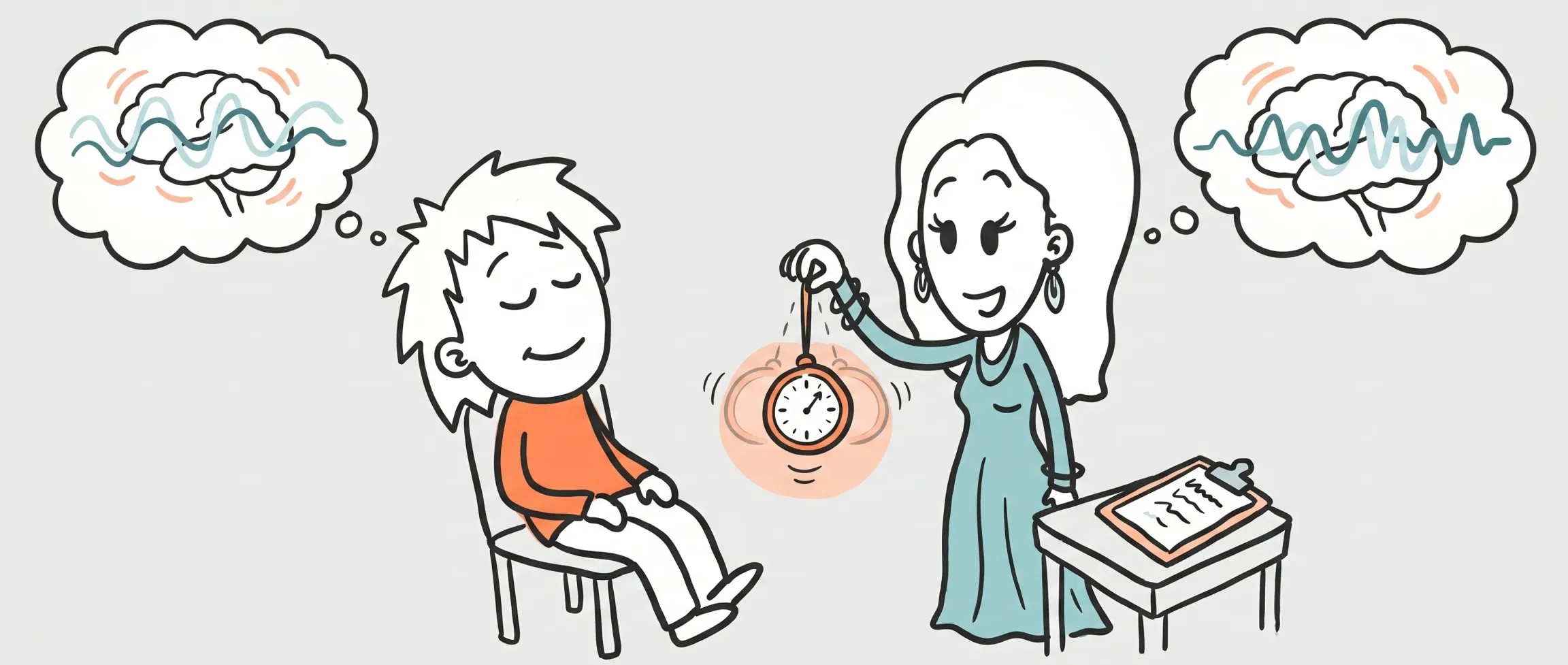
By scanning the brains of people who are under hypnosis, changes in brain activity have been observed. During hypnosis, there is minimal activity in the frontal lobes, which are an evolutionarily newer part of the brain that we normally use for thinking, planning, and evaluating ourselves and others. This may indicate that our critical sense is put on standby during hypnosis.
Brain scans have also shown increased activity in the limbic system, which is an older part of the brain that is very important for our emotions and behavior. This is actually quite fascinating – it's as if the brain shifts gears from the critical, analytical to the more emotional and open.
EEG is a brain scan that measures the brain's electrical activity. This way you can see which parts of the brain are activated. And the interesting thing is that researchers can measure very concrete changes in the brain during hypnosis.
The natural state you already know
Here's something that might surprise you: "It's probably a natural state that typically occurs in brief moments, for example when you're absorbed in a good book, a difficult sport, or an exciting movie. You forget time and place and have 100 percent focus on that one thing," he explains.
Do you know that feeling? When you sit absorbed in a Netflix series and suddenly discover that two hours have passed? Or when you drive a route you know well and can hardly remember the trip? These are actually hypnosis-like states.
The state of inwardly focused attention occurs at approximately 1½-2 hour intervals throughout the day in most people. This so-called ultradian rhythm is a chronobiological phenomenon controlled by a series of "clock genes" – mapped biological rhythms that repeat throughout the day at 90-120 minute intervals. The state is experienced as daydreaming, spacing out, thoughtfulness, absorption, and the like.
What does research say about the effect?
But even though it might sound a bit far-fetched, there are actually a number of studies and meta-studies (research reviews) that have shown over time that hypnosis can help with a multitude of conditions. From anxiety and pain to memory problems and inflammation.
Let's look at some of the areas where research shows promising results:
Pain treatment – when the brain learns to think differently
Brain scans show that hypnosis can dampen the brain's response to pain – even though the pain signal is still registered in the body. We can measure that the brain's response to a painful stimulus can become smaller under hypnosis.
"We have conducted experiments where we hypnotized participants and asked them to experience their arm as numb. We subsequently exposed them to pain and using EEG we showed that when they experienced the arm as numb, they felt less pain," says Bobby Zachariae.
In 2013, a research review - a so-called meta-study - of hypnosis in connection with surgery was published. The meta-study showed that hypnosis shortens operation time, reduces anxiety, pain and medication use, and shortens recovery time. So it's not just "in your head" – it has completely concrete, measurable effects.
The results of this exciting 2014 study show that hypnotic suggestions work very effectively as pain relief. This is based on analyses of 27 effect sizes and more than 900 participants. For 75% of the population, hypnosis provided significant pain relief.
Anxiety – when worries lose their power
Generally, hypnosis has been found to be effective against phobias and other anxiety disorders. This applies to, for example, dental fear, exam anxiety, or fear of heights.
But hypnosis makes you more receptive to the treatment that the therapist performs," says Bobby Zachariae. Research has thus documented that psychological treatment performed while the client is in a hypnotic state is more effective than psychological treatment alone.
And then there's the really impressive study with brain-injured patients:
49 brain-injured patients were treated with hypnosis, and on average they improved their working memory so much that it ended up being at the level of or better than the general population's on some neuropsychological tests. The improvement lasted for 12 weeks that the researchers followed the test subjects.
Children and young people – where hypnosis shows particularly good results
On the other hand, research now shows that hypnotherapy has a positive effect. A result that makes very good sense in many ways for several reasons. Hypnotherapy can change the interpretation of pain in the brain. Hypnosis can likewise help normalize this.
Can everyone be hypnotized?
Generally, people can be divided into three groups: The highly hypnotizable, the low hypnotizable, and the majority who are in the middle.
Highly hypnotizable: Are very receptive and easy to hypnotize. Low hypnotizable: Have great difficulty being hypnotized and difficulty letting go of reality checking. Normally hypnotizable: Can be hypnotized but are not as deep into hypnosis as the highly hypnotizable. The vast majority of people fall into this group.
So the answer is: Yes, most people can be hypnotized to some degree. But it requires, as Bobby Zachariae explains, a trusting relationship between the two. The hypnotized person must thus be directly or indirectly willing to take on the role of being hypnotized.
But does it actually work?
"It's not hypnosis itself that works, but the treatment you give under hypnosis. Because you are under hypnosis, the effect becomes greater, probably because you are more focused and more accepting of what the hypnotist suggests," says Bobby Zachariae.
This is actually an important point. Hypnosis is not a magical cure-all, but rather a state that can enhance the effect of other treatment.
It's important to be aware that it's not hypnosis itself that heals. Hypnosis is a state that makes psychological treatment work more effectively.
What should you be aware of?
"There are a number of studies that suggest that hypnosis can really do something special, but the scientific literature is not unambiguous, and I can also be concerned about whether there is some publication bias in the field," says Jonas Lindeløv.
And it's healthy to be critical. In Denmark, hypnosis is not regulated, so anyone can treat with hypnosis – without having a healthcare background. If you want hypnotherapy, choose a psychologist, psychiatrist, or other healthcare professional who is professionally competent in the field they treat.
Therefore, she and the Danish Society for Clinical Hypnosis want authorization so that everyone who hypnotizes has a healthcare professional background. "We have seen hypnotists who offer treatment for serious mental problems like schizophrenia. This is downright irresponsible, as you can cause enormous harm to vulnerable people and push them to get worse.
The future of hypnosis
In the USA, the American Psychological Association and National Institutes of Health recommend hypnosis as part of standard treatment for pain. And Generally, hypnosis is much more recognized abroad. Therefore, hypnosis is also a natural part of the healthcare system in several other places.
So maybe it's time for us in Denmark to also start seeing hypnosis for what it really is: not mysticism or hocus pocus, but a serious state that can enhance the effect of other treatment.
There are countless studies that emphasize that hypnosis has a beneficial effect. The meta-study showed that hypnosis shortens operation time, reduces anxiety, pain and medication use, and shortens recovery time.
So hypnosis is not magic – it's the brain's natural ability to focus and be open to change. And it's actually quite impressive what we can do when we allow our brain to work in a different way.
If you're considering trying hypnosis, remember to choose a trained professional. Because even though the power of thought is strong, it's strongest when guided by someone who knows what they're doing.